Improve Quality, Reduce Costs: Optimize the Process Instead of Modifying the Die
Surface defects in high pressure die casting not only compromise component quality but also frequently result in significant additional manufacturing costs. Delaminations – flaking near the surface – are particularly critical in areas where sealing surfaces are essential for proper functioning of the part. These defects can impair both the optical quality and the function of the component. Luminus Co., Ltd., Korea, manufacturer of aluminum die castings for automotive lighting systems, used MAGMASOFT® to systematically analyze the physical causes of a recurring surface defect while also evalu-ating them economically. In doing so, the engineers identified the heat flow density ('Heat Flux') as the decisive evaluation parameter. The goal was to understand how and why delamination occurred and to define a robust process window that would permanently prevent the defect while improving quality, process stability, and cost-effectiveness at the same time.
Delamination Despite Robust Series Production
During the development and series production of a headlight housing, delamination defects occurred in the sealing edge area, compromising quality. Conventional optimization measures, such as adjusting the gate geometry or changing process parameters based on experience, did not lead to a sustainable solution. Instead, the engineers reduced the scrap rate through additional manual rework steps – measures that ultimately increased the manufacturing costs. To permanently eliminate the defect, it was first necessary to understand which process conditions were causing the delamination defects and which parameter adjustments were actually effective.
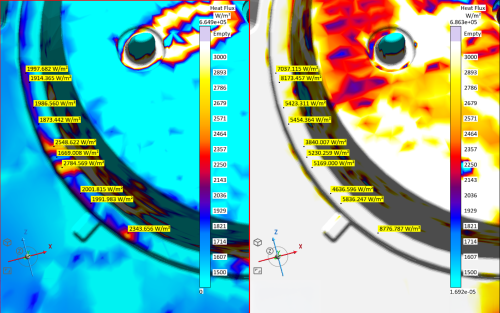
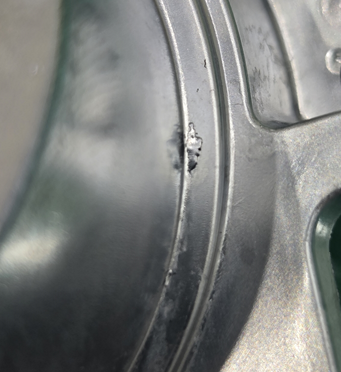
To analyze the root cause, Luminus reproduced the series production process with MAGMASOFT® using the actual process parameters. The evaluation of the 'Heat Flux' result (Fig. 1, left) showed that areas featuring delamination defects (Fig. 2) were characterized by a reduced heat transfer across the melt/die interface. Therefore, the 'Heat Flux' result was defined as the key evaluation parameter. It describes the thermal energy transferred between melt and die per surface area and time, enabling a quantitative evaluation of the heat transfer across the interface.
Evaluation Areas Reveal Thermal Relationships
Using local evaluation areas, the experts analyzed the relationships between heat flow density, local melt velocities, filling time, and filling temperature. The simulation results showed that although the initially applied plunger velocity of 2.8 m/s in the second phase enabled a short filling time, it also caused turbulent melt flows at the same time. This led to a less stable contact between the melt and the die surface. The resulting reduced heat transfer between melt and die (evident in low values for the 'Heat Flux' result) promoted the formation of delamination defects and highlighted the trade-off between short cycle times and stable quality conditions.
Main Effect Diagram Quantifying the Influence of Process Parameters on Heat Transfer
After the evaluation of the 'Heat Flux' result had identified the critical areas, the next task was to define the process parameters having the greatest influence on the heat transfer between melt and die. The goal was to eliminate the delamination defects exclusively by adjusting the process parameters.
For this purpose, both the plunger velocity in the first and second phases and the switchover point were varied. To systematically evaluate the process parameters, a virtual design of experiments (DoE) was performed and evaluated using a main effect diagram (Fig. 3). The analysis clearly showed that the plunger velocity has the strongest influence on the heat transfer between melt and die, as shown by the 'Heat Flux' result. This allowed the engineers to clearly identify and prioritize the relevant parameters. At the same time, MAGMA ECONOMICS enabled a first economic assessment of the variants.
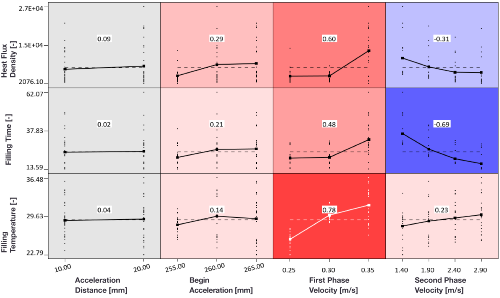
The optimization focused on reducing the plunger velocity in the second phase from 2.8 m/s to 1.4 m/s. The goal of this adjustment was to stabilize the contact between melt and die surface, thus improving the heat transfer. At the same time, the experts increased the velocity of the first phase to 0.35 m/s to ensure a continuous and stable melt flow.
The simulation results showed that these adjustments resulted in higher and more evenly distributed 'Heat Flux' values. This indicates an improved heat transfer between melt and die.
Parallel Coordinate Diagram for Defining Robust Process Windows
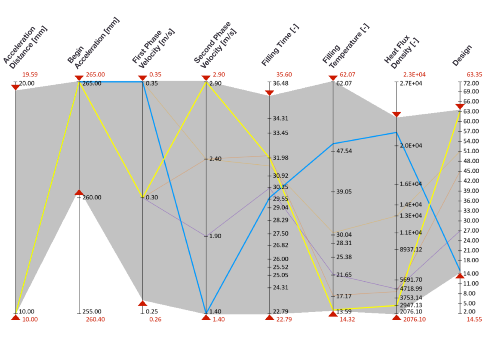
Subsequently, a parallel coordinate diagram was used to define the optimal process window (Fig. 4). The goal was to identify variants providing the most stable heat transfer possible and, consequently, a low tendency towards delamination.
The simulation results revealed that the cause of the delamination defects could be specifically addressed through the process settings: The optimized variant resulted in higher values for the 'Heat Flux' result. The thermal conditions in the critical area became significantly more uniform (Fig. 1, right). The improved heat transfer between melt and die allowed preventing the formation of delamination defects.
Economic Assessment With MAGMA ECONOMICS
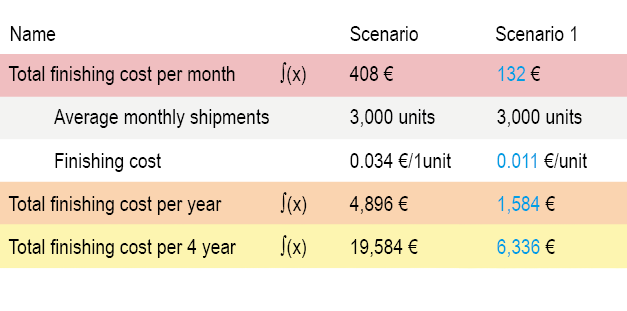
Following the successful technical optimization, MAGMA ECONOMICS was used to evaluate the economic effects of the identified process windows. Prior to optimization, the additional manual rework caused costs of about €0.03 per shot. With a monthly production volume of 6,000 parts, the following savings resulted after optimization:
Approx. €276 in cost savings per month
Approx. €3,312 in cost savings per year
Over €13,240 in cost savings over the planned series production run
The economic assessment with MAGMA ECONOMICS showed that the technically fastest process setting is not automatically the most economically sound solution (See fig. 5). Although the original process enabled fast production, it also promoted the formation of delamination defects, causing avoidable costs through additional rework.
Only jointly evaluating both technical and economic criteria allowed selecting a robust process window for series production – with a reduced susceptibility to defects and lower production-related costs.
Conclusion: Prevent Delaminations, Reduce Costs
The use case at Luminus illustrates how even complex quality issues can be systematically resolved. The key here was not to optimize individual parameters through trial and error but rather to understand the underlying physical mechanisms: In this case, a non-uniform heat transfer between melt and die was the decisive factor, contributing to the formation of delamination defects. Adjusting relevant process parameters allowed stabilizing the heat transfer and establishing robust conditions for die filling and solidification. This prevented delamination defects, permanently reducing additional rework costs. The example illustrates that a physical understanding of in-process relationships forms the basis for both technologically and economically robust decision-making.
